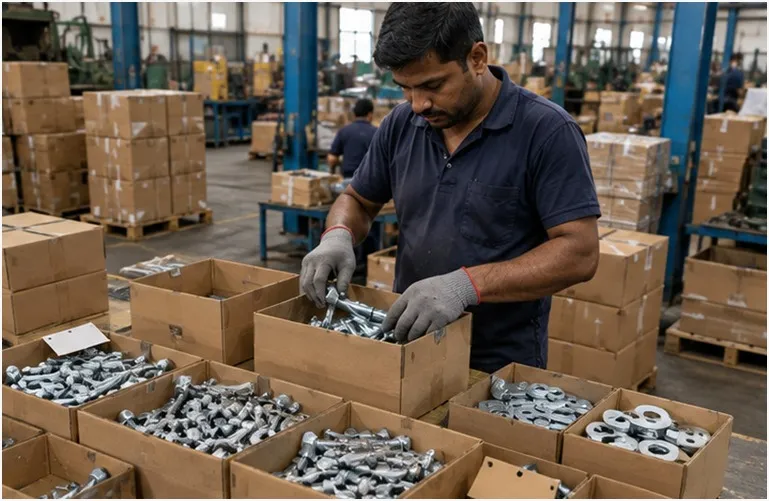
For a distributor, the problem with importing mixed fastener orders is rarely the freight container itself. It is the receiving dock: twenty similar boxes, several overlapping sizes and no quick way to tell whether the right SKU arrived. Canco Fasteners supports cartons, palletized loads, branded packs and barcode labeling within its published capability scope. Those options become useful only when the buyer defines the pack structure precisely.
Start with the distributor's SKU master
Before cartons are designed, assemble a line-by-line list: customer item code, Canco description, size, coating, unit of measure, ordered quantity, inner-pack count and master-carton count. A bolt designated 8 × 60 mm cannot be mixed with another 8 × 60 mm product just because the numbers match; product geometry and specification must remain explicit.
Ask whether the buyer sells by the piece, bag, small box or carton. A wholesale carton of 100 may work for warehouse replenishment but be awkward for a dealer selling packs of 10. The preferred case pack should be an RFQ input, not a last-minute packing decision.
Build a label that helps at the receiving dock
A practical carton label can show customer SKU, plain-language description, dimensions, finish, quantity, lot code, purchase-order reference and country of origin as required. Barcodes should match the customer's inventory system and be tested for scanning after printing.
Canco's published capabilities include branded cartons, barcode labeling and batch traceability. Confirm artwork ownership, printing proof, carton strength and packing responsibility for each product before authorizing production.
Protect the finish without overspending
Metal fasteners are dense, sharp-edged goods. Transit packaging must resist splitting, moisture and abrasion. Depending on the product, liners, protective bags, dividers, appropriate corrugated board and secure palletization may be necessary. Protection must match the coating and the anticipated journey—not simply the most elaborate packaging available.
Buyers should request a packing prototype with real product weight. A design that looks elegant when empty may fail once filled with steel anchors.
Ask for a packing-list structure you can audit
For large or mixed orders, the packing list should reconcile SKU, cartons, net and gross weights and total pieces. Numbered cartons or pallets can help receivers locate shortages without opening every box. If inner packs are branded, agree who checks artwork, quantity and size codes before mass packing.
How Canco fits into the workflow
Canco can evaluate packaging formats alongside production and export planning. The best brief includes a spreadsheet of line items, approved artwork, examples of carton labels, required pallet dimensions and the U.S. receiving location. None of these details should be assumed from an earlier order if the distributor has changed its codes.
Next step: Send Canco an SKU sheet and packaging example via Contact Canco (https://www.cancofasteners.com/contact). Buyers can also review Canco's packaging capability matrix (https://www.cancofasteners.com/capabilities).
Quick buyer questions
Can multiple SKUs share one master carton? Only when the separation, counts and label method have been explicitly approved.
Does a barcode prove correct contents? No. Barcode accuracy and actual packed quantity require separate controls.
What should be approved first? The inner-pack quantity, carton specification, label proof and a representative filled-carton sample.